29.11.07

Fray


CSS is a lovely thing, and lovely things are done with it. This website is a prime example of a good looking quick loading website with interesting design and styling, however, I really hate websites that take you to an entirely re-designed page every time you click a link. This website seems to need to reload itself with entire new layout each link which means the page goes blank while it gets the new content. This site is nice and it's simple but I just find it too annoying to navigate. I'd much prefer the click a link to get the new content loaded into the old layout without having to find all new positions for things. I think it's disorientating and slow for a website that is primarily dealing with quite simply text and images of this sort. Anyway, see what you think.

http://www.fray.com/

22.11.07

This is what we like!


This website allows you to send files from computer to computer via the website without the need to install software. You send the file to the website while another computer downloads the file from the website, this allows people to stream video and music to each. Interesting little project that would be very useful but for me as of yet I've not had any cause to use it. Let me know if you do end up using it much.

http://www.pipebytes.com/

12.11.07

MAKE

This is my brothers textile design company that he set up some time back in order to peddle his T-Shirts to various passers by. This website is however a fine example the sort of the website I like. It's in noway overly complicated, it uses neat popup windows that for some reason are never blocked by my popup blocker and it's easy to navigate. Just thought I'd big up the family Osborne really, take a gander. I have a couple T-Shirts from him, really nice designs in my opinion. I especially like his depiction of prince Harry and William with their cocks out.

http://make-land.com/


Tomato

I'm not sure how this website has been created but I really like the idea of playing with new ways of approaching site exploration. I couldn't work out what was going on at first with this website but when your cursor moves away from the navigation bar the buttons start to disappear until you once again move your cursor back. Is this some sort of PHP script? I'd be interested to know if anyone has any ideas.

Worth checking out though - Tomato

Although I like this website it's certainly not the easiest to access and wouldn't be a website to inviting to the unsuspecting or novice user. Maybe something to be kept (as it is) to the more advanced domain.

Rationale - Pick and Choose iD

I have decided upon the Marvel web comics advert banners for my project. Initially I'd like, instead of exploring flashy imagery and funky animations, to explore clever action script and new approaches in delivering tasters of the comics through the advert banners. Being restricted to 100k file sizes to keep load times to a minimum I thought I'd use a sort of "fetch more data on user request" system to enable viewers to spot the banner containing a taster comic cell and then allow them to interact with the advert to get the banner to fetch another cell to be viewed. In theory the user could view the entire comic (should I let them) through this banner, but of course it would be much easier if they just clicked the "take me to the full comic" button and the Marvel web comic website loaded instead. This would enable me to more or less dodge the 100k file size restriction due to the fact that the user is requesting the increased data and the load time of the banner and thus the entire page would still be kept to a minimum. Of course this may not be possible in full throughout the different banner types, but it is certainly something I'll experiment with when attempting the pop-up ad. All in all I'd like to portray to the viewer that the web comic experience is easily accessible, interactive and above all it's just as entertaining as reading a physical comic.

12.10.07

Usful CSS templates


This website just lists some very basic CSS templates to download and use. As a resource for quick CSS templates to work from this is genious!

http://www.mycelly.com/

And this useful link is a breakdown of clean CSS code. Again, good stuff.

27.3.07

Audio And Visual Techniques: Video Montage Evaluation

Video editing has never been a strong feature of mine despite my interest in the subject, so the opportunity to work on a project such as this was a welcome thing. The assignment offered a casual look at the video editing software “Final Cut” with a manageable final outcome at the end. Video editing for me previously has been almost entirely orientated around the software “Adobe Premier”. Despite Premier being a very powerful editing kit I found it also to be fairly cumbersome and a hassle to navigate the work space, with things shuffled about from the familiarity of other Adobe products. Final Cut I found just as difficult to navigate at first but learnt where things were much quicker. Once I had my head around the layout of the interface and roughly how things were organized I found it to be a much more convenient and of more intuitive a design than that of Premier.
Moving image since the dawn of television has been a beacon of light shining the way for technology. We ride the achievement of the television over that of the space programme and it has become ever more prevalent in society as time goes on, I see no reason for it to slow. Video editing is a very important part of moving image and something I have never even tried to get any real proficiency at. This project has been an important step into a better understanding of video editing techniques, something I would most definitely like to pursue further with future projects.
I am not often one for working in groups and usually find the notion somewhat daunting, in this case however it was welcome. Up until now I have not been involved in any proper group work (despite this work being more duo than group). I enjoyed working alongside Olly, although our first dive into this project was primarily from separate work with communication of ideas over email.
Our first week or so was spent sending emails to and from; discussing the possibilities of various ideas concerning the different words with which we had to orient our outcome with. Our second week we both drafted ideas of what it was we thought the end piece should look like. We chose the word “routine” from the list and decided on trying to convey the idea of routine through a varying degree of mediums within the video. We chose to portray a narrative of routine centred around the aspects of life, mundane and repetitive, without using footage that directly implied this. The aim was to edit the entire thing in such a way that the utilised footage was to be less relevant than how we edited it together; a message through the timing and organization of the footage rather than the footage itself, so to speak.
In the following week we merged our rough ideas together to form a final piece, working together at college and then finally at Olly's house. However, we did end up using Premier software, after converting all the footage we needed, as we were working from a PC. Collecting our thoughts together from the rough ideas we had initially created was difficult and excruciatingly tedious as, in combining a lot of our work, we hadn't taken into account the many possibilities in the final elements of design. We hit many an unhealthy bump in the road when trying to cut our footage together, for example keeping things fluid and without strange ghosts and artefacts (of which there were many) from other seemingly hidden layers of video.
The end result is pleasing, we have created a rhythmic and vastly hypnotic experience of a life sequence that has stayed pretty much consistent throughout development. I think the way we edited and (in particular) the timing we used to transit between the various footage gives a great impression of repetition and the passing of irrelevant time. I was particularly proud that we didn't get sucked into using any of the horrid but easily appliable 'effects' that offer themselves through Premier. However I would have liked to explore the use of sound further in the production, perhaps touching on creating music with short segments of audio stolen from within the clips. Another one of my concerns is that the video may need a couple of decent viewings before the true message that we were trying to portray can be understood. The video isn't really interesting enough for more than one sitting which makes understanding it a slight problem for those who don't have Olly or myself there to explain it.
As far as the narrative of the video goes we were trying to sequence all our footage to the beat of “travel, work, travel, leisure” and for the best part I think we managed this. The segmented and short flashes of the relevant footage creates a very powerful suggestion of what each part of the video is about. The way we organised and timed the shots however leaves the viewer without fully understanding the message. Cutting it up again with the sharp noise and repeating escalator footage intervals really creates a very strange and unnerving day-dream-like atmosphere to the entire creation. This however is precisely the sort of effect we wanted to demonstrate. A sort of insight into to how we thought life goes on, but of course... the viewer probably can't quite work that out without some help. Maybe a draw back to it's design? I'm not so sure, but this is a direction of conveying ideas that I would like to explore in the future. Slight implication, not blunt and forced opinion.
I think our achievement was in creating an excellent first attempt, but hopefully not last, video production. It is obvious to me what it is I would have to improve on in further video editing projects, and what it is that I have learnt in terms of overall information media design. There were a lot of ideas and concepts that I shall expect to surface again in future projects.

8.3.07

The Importance of Play


As part of this study I’m going to be looking at two texts, they are “A Theory of Fun” by Raph Koster and an article published in the International Journal of Computer Game Research that I found particularly interesting; “The Playful and the Serious: An approximation to Huizinga's Homo Ludens” by Hector Rodriguez.

Both texts differ massively from the very basic ‘A Theory of Fun’ to the very long winded study of ‘Huizinga’s Homo Ludens’.

‘A Theory of Fun’ was written by Raph Koster and was based on a presentation that Koster gave at the Austin Game Conference in 2003. Koster is American born (1971-) and is most notably the lead designer of Ultima Online and Author of this book.

Dr. Hector Rodriguez is a New York University graduate with a doctorial degree in the field of cinema studies and is now an associate professor at NYU.

The article that I am studying however is the examination of “Homo Ludens” by a one “Johan Hyuzinga”, a Dutch historian who was one of the founders of modern cultural history (the combined study of anthropology and history to examine popular culture). Homo Ludens is Hyuzinga’s discussion of the influence and importance of ‘play’ on European culture.

There is something in both texts, despite their obvious differences that is agreed upon and is best summed up by Rodriguez as “The player must respond to some event, in the context of a structured situation. Playing consists in a trans-individual process of action and reaction, which often takes on a to-and-fro quality reminiscent of dance.” That is to say that play is a dynamic interaction between player and event that is either counter or imply and follows to a new set of rhythmic events. The main difference is that while Hyuzinga would rather notion towards play being a mundane experience that is simply lived for the very sake of it and Koster implying that play is, although mundane in appearance, actually the mind testing itself through cause and effect so that it may better improve through experience. Koster believes that play is education in such a format that the mind rewards our senses for achieving goals. The structured format of play is simply how our mind best receives the information.

Applying what I’ve learnt from these texts to the production of my game in the case of ‘A Theory of Fun’ was very interesting to do. Koster, although implying very little that we couldn’t deduce ourselves, set about reaffirming and challenging the notion of games beyond that generic and ‘mundane’ word ‘play’. He would like to see games seen as obstacles we pose ourselves for very serious reasons. He outlined good games in his work as puzzles that bare real life relevance. A good example of this is chess. One of our oldest games and still more than popular it was created as entertainment and played by kings no less. It was commonly thought that although the game was primarily just that, a game, it actually taught better command and strategy. It has been proved time and again that people who trend their gaming habits towards more strategy based games, Age of Empires for one, actually improve a lot of real life strategic problems quicker. This of course is open to debate as to whether this is simply that we enjoy things that we already have some proficiency at and thus those of us who do prefer RTS (Real Time Strategy) will in fact already have some inherent command of such skills.

Some pre game production fantasies


A key focus in the game scenery will be the advertising. As part of this there will be 3 major types.

  • Corporate

  • Federal

  • Criminal


Corporate

The setting of the game is aboard a colossus farming ship. It's objective is simply to collect sea based resources (in particular the algae that grows all over the water) and deliver (via small cargo ships) the materials back to the mainlands for sale.

The advertising to this end will be based around the work that the ship carries out, the constant aggressive policing of the floating city and that lovely false corporate productivity banter.


  • Billboards

  • Posters


Federal

The floating farm has progressed beyond a simple corporate platform and become a floating city with citizens born, raised and dying upon it's decks. Due to the state of the mainlands, the famine, warfare and disease that have spread since the moon collapsed gaining placement on the ship sounds like a good deal. It's got work, food and is for the most part safe from the toils of war. However due to the demand for work the ship has become itself a battleground of illegal immigration and poor working conditions.

Policing has become paramount to the floating city state. The advertising on this front will represent

calls for new officers (or as I'm calling them in this game 'prefects'). Along with this there will also be warnings of punishment for criminal actions and rioting.


  • Billboards

  • Posters

  • Fliers


Criminal

Criminal advertising will be in the form of graffiti mostly but also in the form of character speech. Passers by offering drugs etc. There will also be a strong terrorist and rebel advertising present. Posters and graffiti making up the majority of this.


  • Posters

  • Word of mouth

  • Graffiti

Prosumer

Here is a word that I have only recently discovered. One that I doubt we’ll be seeing in the Oxford Dictionary anytime soon. Prosumers; this neologism is the head on collision of producer and consumer. The idea that the consumer and producers would merge in the production of, in this case at least, games. This can almost be seen in Half Life, but what I expect will grow into a much more definitive genre before long.

Half Life isn’t really recognized for Half Life as much as it’s recognized for the shear quantity and quality of the community mod work. Few of us brought Half Life 2, for example, for the core game but for the opportunity to play any one of the hundreds of mods it would spawn after its release. This is prosumerism, a professional industry standard product released and customized to fit by the consumer. Another example of this would be Second Life, a game that is so massive in it’s customization that it’s not so much a professional game anymore as it is our (that is to say, the general public’s) creation. Second Life is nothing without direct community customization. This is the direct result of the massive demand for new and interesting products to hit the market, and in my opinion, the world population feeling a certain lack of identity.

Free Game and Industry Connections

Today’s entertainment industries are some of the most lucrative in circulation and the impact and importance that the video game makes on the market is undeniably the largest portion of this.

For me however the most impressive aspect of the games industry doesn’t dwell on profit margins but in the ever growing free game and community ran games out there.

As never before we are seeing a massive increase in creative free exchange of information and ideas on such a structured level. Games such as half life with its extensive modders support are just an example that I’m sure most of us can relate to. Taking it further however is the increased rate at which games at industry standard are created entirely from scratch on a community collaborative effort are emerging. Games created via communities of enthusiasts with all manner of varying skill levels and experiences are pulling towards common artistic goals.

A fantastic example of this is the excellent “Total Annihilation: Spring” project. Based on the popular and now aging game “Total Annihilation” this project features a very clever Wiki style creation allowing any person to add material towards the game to be used openly by the developers. This project, not even nearing a level of completion, has already managed to inspire huge levels of modding and scripting to enhance the core game beyond its original intent.

However like most things there is of course an element of finance to couple great ideas, in the case of free games a lot of bulk of a game will be compiled through a few key members and projects like this do stem a lot of their success through not only the community submitted work but also from the donations. Furthermore to this there is the serious element of industry recruitment. A lot of the big name games companies now have at least one, if not many, game designers working for them that were directly recruited because of their free game and mod work. An example of this would be the Doom 3 key level designer who was recruited by the company from the maps he made for Doom 2 all those years ago. A simple boy creating simple yet interesting maps for one of his favourite computer games he now resides within the pay roll of one of the worlds leading games studios.

29.1.07

Some Initial Work, The Island Game Project

So we're planning our games round an island. A narrative (physical or otherwise) that restricts the user in some form or another. I'm going to take a few key elements from the word Island and bundle them into my game.
Firstly, as I detailed earlier, my game will be following a relatively linear concept. You progress through the game world in order to read a story that I have set. Deviations from the path may well be introduced but for the most part you are being directed by me, the narrator.
Firstly, and most probably the incorrect way of going about it, I wanted to make the game engine (if that's what it can be called) based on my first thoughts about concept.
Because the story is linear and because the game is point and click I wanted at least to have the interface interactable. A scroll map, one you explore through mouse control.
After talking to Anna-Beth about the concept that I had for a scrolling map I created the following code:

a = Stage.width;
b = 565;
doStuff = function () {
x = _root._xmouse;
b_mc._x = (b*x)/a;
};
setInterval(doStuff, 1);

In short this would direct an image (the world) to position itself on the stage at a point relative to the user cursor. I'll describe how it should behave:
We define 2 variables. The first, "a" is set to obtain the stage's (that's the area in flash you work with) width. The second variable "b" is set to the width of the image we wish to scroll.
We then have our code, this I set as a one tick function with an interval to repeat it.
In theory the variable "x" will capture each tick (that's the frames per second tick, each time the frame is loaded) the position of the mouse on the stage.
I named our image "b_mc" and have the code position it's "_x" location (that's the distance along the x axis (the width) to variable "b" multiplied by variable "x" and divided by variable "a".
The set interval at the very bottom simply tells flash to replay that code, which I named "doStuff" every 1 milliseond. Flash counts in milliseconds, i.e. 1000 = 1 second.
Unfortunately this code almost but not quite works, the image scrolls and will match to 50%. i.e. if I placed my cursor on the far right of the stage the image will align. However, if I place my cursor on the left of the stage then the image will only mark half it's distance. I've no idea how to alter this as my maths is shocking to say the least and the idea is now obsolete to another anyway.

This method is a great way to allow a user to search a small area but after much deliberation I figured I would return to my original plan which I shall go through in the follow:
The map (the area the user explores) will scroll along the _x plane at a speed and in a direction based on the position of the users cursor upon the stage.
i.e. If the user places his/her cursor on the far left of the stage then the map will scroll away from that direction, as if the user is searching the map with his mouse.
With this system the user will be able to search a map of any size whereas the previous idea would have made a very large map very touchy and sensitive to navigate.
I shall detail the code I have thus far:
Now, we're assuming we've made a movie clip that is larger in width to that of the stage and that we've named it "city_mc". This is our map. A few things to note before I explain the code. It's good practice to have everything code driven in your production held within a single frame and as rarely as possible within movie clips. This allows for much more precise control over your production and makes it easier to read what's going on. This code is all nestled in my main _root frame. Also, I've tagged my descriptions with "notation" marks. These marks usually look like this "//" . What they do is tell flash to ignore the follow code as it's there for reference and not for flash to use. In this case however I've used the larger notation marks which you can use to bracket larger text together. The "//" only works for a single line whereas "/*" defines an area. The area is defined with /* at the beginning and */ at the end. Just like brackets. If you wish to test this code you can copy and paste it ALL straight into Flash.
One last point, I apologise for my US spelling of the word "center". Flash works with US spelling and it's just something you'll have to ignore.

--------------------------------------------------

city_mc.onEnterFrame = function() {
/*First we target our movie clip which we've named "city_mc". Then we let flash know this is a per frame tick function with "onEnterFrame". Finally we tell flash the following is the function we wish to be executed by opening our statement with the "{" bracket.*/

center = Stage.width/2;
/*The first line of code in this function defines a new variable. A variable is code association. We define for the code a word that means something else. In this case we've told Flash that "center" actually means the "Stage.width/2". Which in short means the word "center" when used within the code actually means; the stage width divided by 2. This is an easy way of finding out the center of the stage and referring to it later./*

if (_root._xmouse<=center) {
/*Our first "if" statement. A statement is a collection of code contained within the curly brackets "{ }". These "if" statements tell flash that the following statement is to only be executed if certain specified conditions are met (that's the bit contained within "( )" brackets) . In this case we're saying "if the _x position of the mouse on the stage is equal to or less than the center of the stage, then you may proceed with the statement". Remember we named "center" as a variable for the center of the stage! Now if the condition is met, then the next line will be executed.*/

if (city_mc._x<=-10) {
/*Here we're making another if statement, this way Flash will have to meet 2 conditions in order to proceed. This statement is to stop the map scrolling further than it should. We don't want the user to just scroll to nothingness. Now all this part of the code is about the mouse being on the left hand hand side of the stage and thus making the map scroll to the right. So here we say: "if the map (city_mc) is positioned on the _x (horizontal) axis less than or equal to position -10 then you may continue". If the conditions are met then the next line is executed.

city_mc._x -= (_xmouse-center)/40;
/*This line instructs that: "the position of the map (city_mc) on the _x axis should be it's current position minus (symbolised by "-=") the following". This effectively will move the map each tick by "(_xmouse-center)/40;" which in short is the _x axis position of the mouse minus the "center" variable and together divided by 40. This results in the map being moved to the right at a speed relative to the distance of the mouse from the center of the stage.*/

}
/*This bracket defines the end of the current if statement, but not the statement this one resides within!*/

if (_root._xmouse>=center) {
/*Now, this is a third if statement. The following code is dedicated to the opposite direction and works in exactly the same way bar a few "numerical and comparison operator" changes. Comparison operators are "<=" and the like, operators that compare properties. */

if (city_mc._x>=-2200) {
/*In order to obtain the _x position of our map that we wish it to not scroll beyond we simply align our maps right hand edge to the right hand side of the stage and copy the number in the _x axis property window for the movie clip. Simple enough. For the left hand we can assume that it will always be 0. However I made i -10. Just to be on the safe side.*/

city_mc._x -= (_xmouse-center)/40;
/*This repeated bit of code will move the map the opposite direction as well since our mouse position will now be into the positives numerically which has the effect of increase when 2 negatives are used. I don't expect you to understand that as neither do I and it took me much trial and error to work it out as well!*/

}
/*This ends the current statement*/

};
/*This ends the entire statement. The code is now complete and because it's a "onEnterFrame" function it will if all goes to plan, just run it again next frame. The ";" marks at the end of the curly bracket tell us that this is the end of a code block.*/

Well now that's the code for the scrolling background. It's quite small and simple enough to understand once you get your head round the basics of action script. I'm going to paste now ALL the code I have. I'm not going to explain it all as there's a lot there and most is completely irrelevant. However I did take the time to add a little notation which might help guide you. Basically in all this code we have several map layers driven, plus some sky and even some rain. On top of this there's some looping ambient music which plays in the background. There's some notation in there that you may not understand, your not supposed to. It's just me saving some un-used code should I need it in the future. The notation marks just means Flash ignores it for the time being. I recommend you paste this code into Flashes action script box so you can read it easier. Thank you.

--------------------------------------------------

stopAllSounds();
/*Attaches and loops the music*/
//create new empty sound object
musicDrone = new Sound(this);
//attach the sound to the empty sound object
musicDrone.attachSound("acz.wav");
//play the sound object. 0 = start possistion and the 999 = the loop times
musicDrone.start(0, 9999);
music = new Sound(this);
music.attachSound("short.wav");
music.start(0, 9999);
/*Create rain*/
//creates a variable with number 0 assigned
rainNum = 0;
//Create a function to run random steam noises
steamNoise = function () {
randomNumber = random(2)+1;
trace(randomNumber);
if (randomNumber == 2) {
steam = new Sound(this);
steam.attachSound("steamLong.wav");
stam.start(0, 1);
}
};
setInterval(steamNoise, 1000);
//Creates the function to follow, called rain
raining = function () {
//incriments the rainNum in integers of 1
rainNum++;
//creates a variable called rain and attaches the raindrop clip to it
var rain = _root.attachMovie("rain_mc", "rain_mc"+rainNum, rainNum);
//places the raindrop in a random location along the width of the stage
rain._x = Math.round(Math.random()*Stage.width);
//gives each raindrop a random transparency
rain._alpha = random(20)+15;
//random speed
rain.speed = random(30)+20;
//random _xscale
rain._xscale = random(80)+20;
//random _yscale
rain._yscale = random(80)+20;
//on each frame the following function will run for the variable objects "rain"
rain.onEnterFrame = function() {
//commands each dropket to move 3 pixels downwards each frame
rain._y += this.speed;
//commands each dropket to move 1 pixels left each frame
rain._x -= 3;
//The following removes the droplet once it leaves our view.
//If we left the raindrops to accumulate without removing them they would slow down the game
//This says, if the _y (height) of the droplet falls below the lowest stage coordinate
if (rain._y>Stage.height) {
//If the previous is true, then the droplet is removed on the next available frame
delete this.onEnterFrame;
this.removeMovieClip();
//This decreases the rainNum count so that the rain doesn't reach a depth that we require other objects to reside on.
}
};
};
setInterval(raining, .1);
/*Scroll top & rear landscape
To reverse the direction the backgrounds scroll switch "-" with "+" and vice versa.
"+" will scroll towards the direction the mouse is sitting on
"-" will scroll the opposite direction to the mouse
The "+30" and "-30" at the end of the if statesments are to give the stage a un-reacting dead zone. Anything 30 pixels left or right (60 pxl spread) of the center will have any effect*/
city_mc.onEnterFrame = function() {
trace(city_mc._width);
//This is the work out the exact center of the stage. Stage width could be anything
center = Stage.width/2;
//Scroll right (mouse on left)
if (_root._xmouse<=center) {
if (city_mc._x<=-10) {
sky_mc._x -= (_xmouse-center)/100;
city_mc._x -= (_xmouse-center)/40;
city2_mc._x -= (_xmouse-center)/45;
city3_mc._x -= (_xmouse-center)/50;
city4_mc._x -= (_xmouse-center)/55;
} else {
trace(city_mc._x);
}
}
//Scroll left (mouse on right)
if (_root._xmouse>center) {
if (city_mc._x>=-2200) {
sky_mc._x -= (_xmouse-center)/100;
city_mc._x -= (_xmouse-center)/40;
city2_mc._x -= (_xmouse-center)/45;
city3_mc._x -= (_xmouse-center)/50;
city4_mc._x -= (_xmouse-center)/55;
} else {
trace(city_mc._x);
}
}
};
//This stops play on this frame
stop();
/*fscommands are used to control the window and some limited OS features*/
//This turns the flash screen into a fullscreen
//fscommand("fullscreen", "true");
/*Attaches and loops the music*/
//create new empty sound object
//musicDrone = new Sound(this);
//attach the sound to the empty sound object
//musicDrone.attachSound("introBassBoost.wav");
//play the sound object. 0 = start possistion and the 999 = the loop times
/*musicDrone.start(0, 9999);
_root.start_btn.onRelease = function() {
gotoAndStop(3);
};
stop();*/

--------------------------------------------------


At First Glance, The Island Game Project

A while since I've posted anything so I thought I'd write up a not so quick message detailing some of the work I've made thus far on my game design project.
I've been reading up on my game design, in particular a book called "Theory of Fun" by Raph Koster. A very valuable resource if your going to get anywhere in game design and yet I find myself ignoring some of it's most important points.
Firstly and foremost the game should challenge our skills and we should be able to improve through the game some very fundamental human abilities such as spatial awareness in first person shooters and our sense of planning and resource management in real time strategies. In order for a game to remain exciting it should constantly challenge these skills while still keeping the goals it set's forward obtainable. The game should be not so easy that we get bored and not to difficult that we might get frustrated and abandon it.
I searched for a game that sums these ideals up. I came across "missile 3d". This is a game based on a concept that I'm sure most of us are familiar. Guide yourself (the cursor, whatever) through a the levels while avoiding certain obstacles. Give this game a go, it's addictive because it's both challenging a skill we put to use everyday ( orientation, spatial awareness and concentration) while remaining rewarding enough for us to replay.

Missile 3D - See if you can beat my score, 89% through level 6.


Now I mentioned my game would be different, it shall be in a sense. The reward of the game won't be obtaining physical objectives such as FPS and RTS games but instead it shall play like a book. You interact with the world in order to read a story. Some objectives may well be introduced in order to keep the user reading the story in the correct order and I may even create some multiple directions in the outcome.
I'd like to think I'm exploring a new approach to reading a book but this idea is far from new. I'm just mixing a few different methods together in order to create an idea that has in many forms been done before. For me however this is very new, and I'd be interested to see where I take it through the course of it's production.

14.12.06

Task 3 - Evaluation

I set out to make a web based slide presentation of a computer game of my choice, for all intensive purposes I think I've succeeded.
The site is to the point and contains the theme I had originally intended and set out to achieve.
The only downfall to the site is that I didn't get hold of better quality imagery, however this is mostly overlooked when the site is run in it's intended 800x600 resolution.
Although the website runs perfectly on a Windows based PC for some reason a mac has difficulty rendering some of the images used within. I'm not sure why this is but it's something I'd like to know how to overcome as most of my work is now based on macs.
It would have been nice if I could have included some streaming video into the presentation but as it is I couldn't work out how to get things to load properly and for that matter find video's that were of stream able size on the web.
It's unfortunate that the game I chose to promote hadn't released a proper web kit with their designers pack, the kit is very out of date and thus I could not show off the true graphic splendour of the game as I couldn't have it installed to screenshot for myself.
I would have also liked to give the site some more time dedicated to dynamic and animated content, this is something I'd be very interested to include in any future projects I undertake of this sort. A lot is lost in the presentation of the game as I could not get enough animation included.
The show was a success on the whole, there are definate points I would like to have remedied and the comments left by students in the class have given me a real insite into how the flash application could have been better put through it's paces.

Grotesk and Monstrous

A wonderfull website, it's clean, has beautifull sound and visuals. The site is immersive and concise. It's got wonderous illustrations and has had my attention and admiration throughout this and my previous course.
Most of my work stems down to just a couple of websites for inspiration, this is one of them!
All done in flash with some very nice steaming imagery.

Task 2 - Website

Follow this link to view my website.

Evaluation

The website works, it's concise and it's (in my opinion) well layed out. The major and really only regret is that I could not get 'just' the new content to load and have the banner and nav bars to stay constant. This is something I'd like to look into during a year 2 product. Investigating more advanced code languages and create a more dynamic website experience.
This website however is perfect and just what I needed it and intended it to be, bar one minor detail. There's a flash addition situated underneath the nav bar that does not load when on the web but seems to work fine when run from a local source. Odd, but to my best attempts unsolvable. However annoying it is the flash item under the nav bar was purely cosmetic and not that good anyway so no harm done.
The website contains everything it needed to contain and manages to maintain a constant style and is easy to navigate and use.
There is one element to the website that I feel set's it aside from others and that's the mixed up language/spelling used on the nav and title. I like people to view my work and find it not immeadiately accessable, I want them to spend just a moment think about what they're seeing. This is something I think playing with the text in this manner achieves well.
The project was for all intensive purposes a success and a style and basis I would like to work on in the futre.


Research

Angry Blue

This is a web design, illustrator and general new media artist that I adore. His primary role is to create band art, posters, CD covers and mechandise and has worked with some of the most widely famed bands there have ever been.
His art is somewhat odd, far from unique, but tends to hold well to his particular style. However, he's a good media designer to employ as he follows briefs set very rigorously. This can lead to some of his art being somewhat disapointing but at the same time admirable as he takes difficult tasks and succeeds to inject brilliant illustration and design.
His website is lovely, it's plain and simple to navigate and portrays all his hall mark designs. It's very well layed out and a perfect platform to advertise his skills as a media designer.


Task 3 - Progress


What I Need

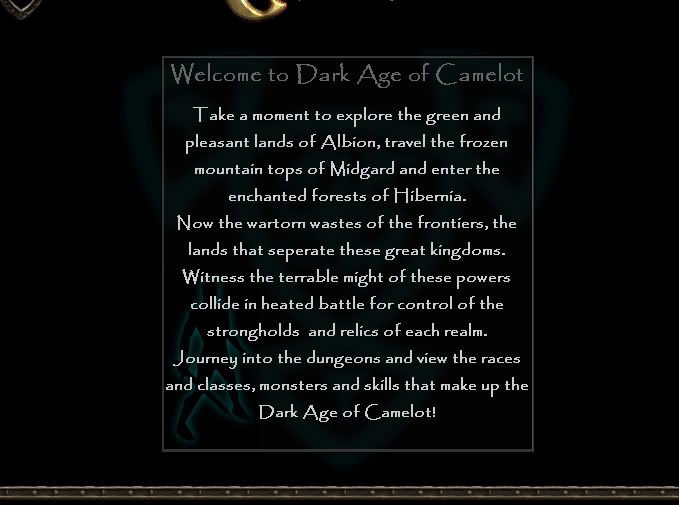
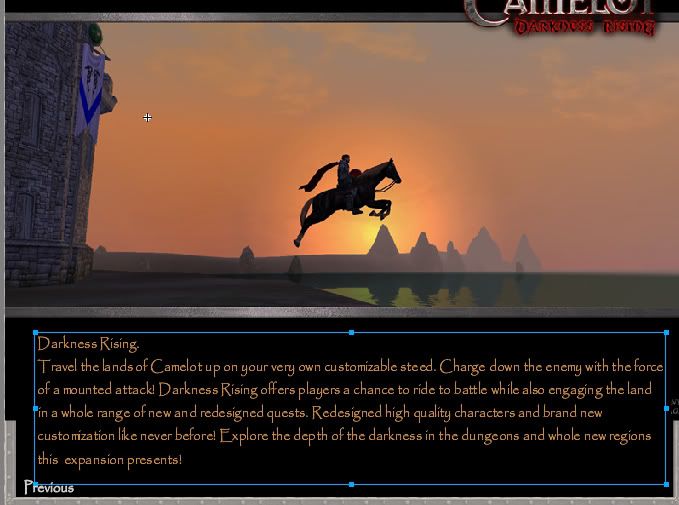
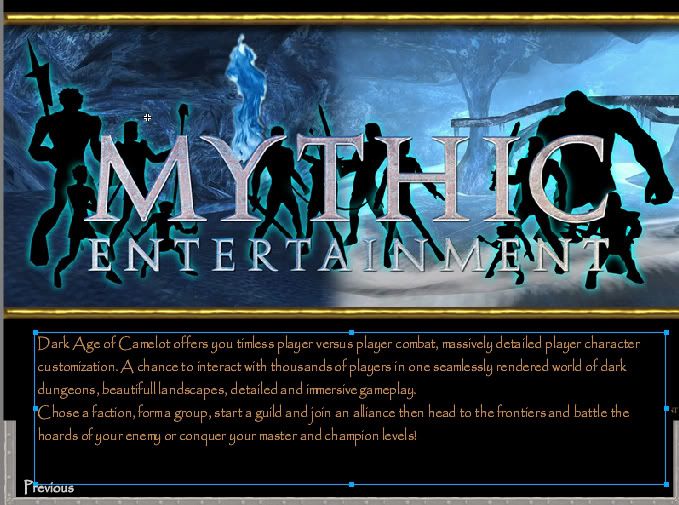
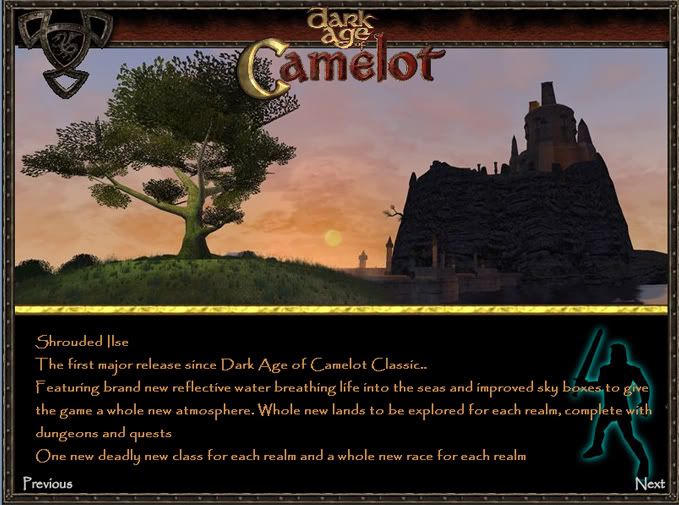
The first thing to look for is to get the slides looking as if they've been themed as the real Dark Age of Camelot team would of themed it. This I think would be best explored via a webkit. Most games, and to my knowledge this one as well release webkit's. Packs containing graphics and various web materials for building fan website. This is a great way for the game to promote itself through methods that both cost nothing in money nor staff time.

Making the show:


  1. Take border graphics from the main DAoC website along with banner graphics from the webkit.

  2. Background applied, simply the glow background from one of the webkit graphics.

  3. Fade applied, when a screen is changed it will flick to black and then fade out to the new graphics being displayed.

  4. Added next button and next page.

  5. Added previous button

  6. Added initial slides

  7. Gave slides and transitions between pages a fade.

  8. Re-did the title bar

Final step included polish the edges with black strips and borders while at the same time adding the final slide which displays the creators tag.


Task 3 - Initial Work

Rationale

For my project I will be attempting to design an aspect of advertising for a computer game. I have chosen the game and the advertising will be a sort of web based slide show that tries to show off the aspects of the game that potential customers might be most interested to see.

In order to create this I will be asking people to fill out questionnaire's and investigating already practised forms of game advertising. I shall be asking primarily into what type of player I'm trying to reach and what sort of styles would be most fitting to reach this end.

The idea of this web slide show is to promote the game quickly, effectively and without forcing the user to trawl for detail himself. This is also a perfect platform for advertising very selectively. Leaving out information or spinning information that has driven old users away. The game I have chosen has many downfalls and is currently supporting it's slowly dwindling numbers on old faithful players with very few new comers. Any accounts made again are almost entirely made up from returning users. This shall play a major aspect in the advertisement, trying to persuade old users that the game is worth returning to.

In respect to the design of this presentation I will be using the already established theme of the game and be making it in flash to allow for the greatest use of visual styling and clean modern look the game needs so sorely.


Questionnaire

How old are you? Circle one

10 and under / over 10 – 15 / 15 – 19 / 20 – 29 / 30 and over


What gender are you? Circle one

Male / Female


What top 5 features do you look for in a massively online multiplayer role playing game? (MMORPG)


Do you prefer a game to be complex or simplistic? Circle one

Simple / Complex / Not bothered


Do you like your games to feature mature content. Gore and the like? Circle one

Yes / No / Not bothered


Do you look for good graphics in a game?

Yes / No / Not bothered


Do you look for a game that will run smoothly on your computer?

Yes / No / Not bothered


Is player versus player combat important in an MMORPG?

Yes / No / Not bothered


What is your favourite MMORPG?

.........................................


What my Questionnaire Returned


In my questionnaire I tried to determine what would be the best things to advertise and in what order they should be advertised on this web based feature's slide show.

The age rage is primarily from 15-19 on the questionnaire but on asking players within the game how old they were the reply was mostly between 20-30 with some exceptions leading to almost 50!

Features that the questionnaire determined as being the most sought after were a large player base most of all and a particular attention to the player versus player detail of the game. Both aspects are not unique when it comes to a massively multiplayer online role playing game such as this but in any cases are usually some of the most important aspects to focus on.

Another item raised by the questionnaire that bares particular importance to this game is the fact that advancement past the highest attained level should be important. This is very important especially to this game as it's going to be aiming a lot at returning old users. Advertising the advancement the game has made recently to show of what new points of interest the game has to offer and what the old users might not have tried yet.

As with most MMORPG's this game is one that updates it's content on a fairly regular basis with new expansions being released along side continually added features and fixes.

Players of Dark Age of Camelot are on the whole of the older age range and on the whole enjoy a game that is complex to play and tricky to master. This is something Dark Age of Camelot does offer. This game is not for someone who has a dislike for number crunching and tactics. However, this isn't something that most new users would be looking for in a game so this is something that I shall be practising selective advertising on. I will however mention in an under hand way that the game does feature many customizations that require some serious thinking. Hopefully in a fashion that most new users might overlook.

All the questionnaire's returned that users look for a game that runs smoothly on their computers, this is something Dark Age of Camelot does achieve and something I will be making a particular note of.

The greatest thing this game does feature is it's attention to the player versus player combat aspects. It's taken the idea of combating players to a previously unforeseen level, especially with new and recently released features.


The Games

The questionnaire returned 4 favourite games. Only three mostly due to the fact that the only people I had available to me to ask in person were people I have met before. The trend of games tends to circle close when it comes to acquaintances of mine.

The four games were:
Ultima Online

World of Warcraft

Jennifer Nation

Dark Age of Camelot


Ultima Online:

This game has been around since the dawn of time, it's one of the first of it's kind and boasts still some of the most immersive game play your likely to meet. Since the good old days Ultima Online has changed little and yet still maintains a good honest (and somewhat ageing) player base mostly consisting of over 30's.

The features it likes to press the most is it's age, this is something Dark Age can't rival but it is something it can say it has of it's own. Dark Age has been around a long time and has created some new unique concepts that other games are now trying to copy.

In particular to Ultima Online, and what in most cases keeps the players it has, is it's sense of community. The servers (or shards, as MMO's like them to be called) are quite small compared to modern standards and at the most will never have more than a few hundred players on at a time. Dark Age can support well in excess of a thousand players.


World of Warcraft

We've all heard of it and like it or not it is massively popular among most age groups. It's a trendy game that's loaded with features. However the thing that let's this game down is it's complete lack of depth. Once you've hit the top that's really where you stop and most players don't even reach that before they get bored of the linear and repetitive gaming.

Dark Age can't be rivalled on it's features beyond it's maximum level, in fact a lot of players even loath it but it is something that new players don't consider and old players would be interested in. Dark Age tries to cling onto the players it has by enforcing how much there is to do for players that think they've almost got it all covered.


Jennifer Nation

This sweet little game isn't really much to do on. It's a role playing web browser game that features no player avatar and instead is a micro management game based on moral dilemma's. I shan't be looking any closer at this.


Dark Age of Camelot

I shall cover this in a different section.


What I Need to Include

Aspects:

Player versus player combat:

This featured highly on the questionnaire, more or less everyone requested it.


Customizations (Character development)

Player classes, character statistics and the sort of play styles available


Player presence (Character building)

In a massively multiplayer online game with many other players being an individual is hard and a game that promotes a large sense of unique presence is usually onto a winner. This was something that came up as being quite important in my questionnaire.


Quests

Questing is an integral part of role playing games, it's something they all have in common in whatever forms they take. DAoC is no exception with massive amounts being churned out and a recently released expansion dedicated to quests among other things.


Groups of players

The questionnaire showed that people are after a game that features the ability to 'group' with other players to participate in events. Dark Age has this down to a fine art with many grouping features. This is something I'm going to play on as an MMO is often very group orientated.


Graphics

Dark Age is an old game and it's graphics were becoming outdated but it's managed to stay ahead of the competition in many ways by keeping itself updated with the recent remodelling of many in game elements. I think I'll have to have a slide dedicated to the graphics that it shows off best.


Size of the player base

MMO's are about the players, Dark Age although dwindling since it's prime day's has managed to boost per server player bases by merging servers and combing certain area's with other servers. A server in the US will never have any less than 300 online and will usually push at least 5 or 6 hundred. Populations often reach in excess of one thousand and can even get as high as two or three thousand at peaks.


Item craft system

One questionnaire mentioned they liked MMO's with an item craft system for players. This is something I'm fond of as well, it introduces dynamic economics and adds a whole new dimension to what's going on in the game. A game such as this orientates itself on the dynamism of the virtual world, this is a great way to invoke this emerged and dynamic feeling we crave.


Story

The defined game story is often unimportant or at least mostly ignored by players who prefer to focus more on the player orientated events and plots. However, a plot of at least some description is often required to give the game direction and let players know what's going on.


Online continuous play

A gaming world that doesn't sleep, it's something that all MMO's will boast and something that DAoC doesn't lack. Once your character logs off the game doesn't end, players continue the plot and events still take place even in your absence. This should be made well known in the slide.


7.12.06

My Images (right) analysed

Many of the influence's that govern my work comes from exploring random sites and anonymous artists that I have found over the years. I very rarely stick to one specific influence nor do I prefer to keep my work in any particular style. However, influences that definitely have governed my work have been the work of American new poster artists. In particular, Angry Blue. Primarily the artist who works mostly under the seudonym of "Angry Blue" creates band art, CD covers and advertisement in still print.
I like my work to come out as if somewhat disturbed. Human figures often are the centre of the attention but rarely look like a normal human being. When someone views my work I would like to think they remember it for it's mis-shapen forms and techniques that give the figures a pained look. When something doesn't look quite right, but not entirely wrong, people tend to pay attention more closely and in the end remember it for longer.

Binannary
This image was created from a photograph of my girlfriend that I traced over using 1's and 0's. Binary + Anna = Binannary... get it? Clever aren't I?
This image (best viewed on a mac, for some reason) was created with the intention that it be shown on a massive scale. The image would only form once the viewer moved back from the image. It's not a very original idea but it is one like I'd like to explore further. It's very based on the art movement "ASCII".

Tale
I love forcing two images together. This is something that most media designers experiment with at some point in their lives. In this case the image of a cat + a woman were the only two images I used. As for influences on this one, they really do just come from the experimentation and browsing of art related websites.

Lick
I wanted to use the image of a beautiful woman, in this case a stripper, and then alter her face to make her appear less beautiful but without altering the dynamics of her face. I.e. no mindless nudging and warping but instead to overlay images on top of her. This again has been created using just two images. That of the woman and that of a scar from a boys arm.

Bent Over
This was a doodle, I like experimenting with form, such as in most of my images again it's a person. I love to take a recognizable shape and transform this into a still recognizable but somewhat crippled form of what it 'should' be.

Scared of You
This is very much influenced by the American poster art that I spoke of previously. The idea was to create a scene that was not explained. We know there's two figures, they look humanoid, but we can't work out why they're in this huddled position or from where/or what time they represent.

Photo Essay (baby grow)


Surrealism

The movement arose shortly after the end of World War I in France. It was a reaction to Dadaism, which in turn was a reaction to “logic” that which Dadaists believed had caused the war. Whereas Dadaism sought to revolt against logic with near pure chaos Surrealism sought to rebel with more structured manipulation of reality. Surrealists preferred to use psychedelic studies into the sort of mind analysis Sigmund Freud would make. They would try to explain the human mind by forcing people to expand and confront its boundaries.

Although surrealism is most commonly associated with the visual art it extends to most forms of artistic expression. Alongside the artists were the poet’s in particular. Mostly the poet’s would write about love and nature. Although surrealism did exist in most other forms of art it was mostly a point for other related mini movements to spin of from it. Usually start in a definite sort of art type or the other. Sculpture, prose and the like.

Semiology

The study of signs and symbols; the implications, invoked sense's and how we relate to each in connection to one another, the final conclusion or even the implied conclusion in relation to every active signified or signifier.
Semiology is the study of how meaning is created, not what it is.
The problem with semiology is in the very definition of the word applying to every aspect of our lives. The word itself confuses its own conclusion in that it is subject to relativity, more or less its own study. Signs and symbols do not carry a solid universal meaning, this extends to all forms of such, even lettering.
Even though semiology is technically very difficult to define, it is this very confusion that makes it very hard to disprove an argument on its definition. My understanding of the word, based on the forms presented to me thus far is this.

Semiology is more than the study of signs. Semiology is the study of age, social class, fashion, quadrivium, the junctures of these and many other aspects. Semiology is how we perceive the world through a relative perspective and how more importantly we perceive other’s perceiving the world.

An example of a semiotic study:

A cigar; a sign of wealth, relaxation and an easy life. The proletariat might perceive this to be a sign of things out of their reach perhaps? The smugness of the bourgeoisie? Furthermore to this we must consider its placement, is this item found as an image or a physical prop? As an image we immediately try to find more its meaning than simply an item. Item’s (I feel) are considered more an immediate acceptance and thus less is thought of them whereas an image is to invoke feeling and an item is usually (in this case particularly) created for the usefulness to ourselves, not for others. Example:

A cigar is used by us to smoke,

A picture of a cigar is more commonly used to the designers end. Advert imagery etc.

Tracing semiology back it is most commonly associated with the Swiss linguist Ferdinand de Saussure and American philosopher Charles Sanders Peirce.

Semiolingo

Sign: The very basic unit of meaning. A sign is something that creates meaning. (Umberto Eco’s wrote: “a sign is anything that can be used to tell a lie”).

For every sign we have two major aspects:

Signifier: Any material thing that signifies, e.g. text, facial expression.

Signified: The concept the signifier refers to.

For instance the text “man” is the signifier. When we read this we think of a man, this is the signified.

Denotation: the relationship between signifier and signified. The literal meaning of a sign. The text “man” signified to us a male human.

Connotation: This is when a second signifier is introduced. For instance if we introduced the text “idiot”. The picture of the man is then not just a signified but becomes a signifier as well. The signified is the picture in your head. A stupid man maybe?

6.12.06

Leonardo da Vinci Exhibition

A couple of months ago I attended an exhibition of some of his work at the Henry Moore institute. More specifically this was directed at work rescued from some of his sketchbooks. It's quite an incredible thing to actually see work at two inches from your nose that has been drawn (as in some cases) in complete day dream ignorance by one of the worlds greatest thinkers and artists. Due to the age, paper and the condition in which they were kept the sketches had even picked up print from pages they were kept against, illuminated in the gallery with clever lighting you could see text and doodles layered on top of each other.
The gallery room used was small, the collection not huge either but the gratification from being able to get so close to the work was just fantastic. Leonardo has always been one of my favourite artists. Not for his oil work which receives greater attention but for his genius sketch work. There's something that conveys more an artists skill in sketch work than in all his most celebrated work combined. Something in the fluidity and the thinking I feel is lost when work is planned. I prefer a more instant transcribing process between brain, pen and paper. When viewing exhibition work that contains sketches you can feel so much closer to the artist and what he was thinking. The moods and the feelings he was experiencing at the time. Doodles are like snap shot views of the inside of a person.
I particularly appreciated in terms of the gallery how they planned the space in which the work was laid out. The room was mostly a dull matt white and the work contained within glass casing's which were in most cases illuminated from behind as well as general area lighting. Some of the work was suspended in the air via metallic woven cords and double backed glass frames. The effect was quite clinical and modern which was a really nice touch to an exhibition of what is commonly associated as rather ancient art (although as time goes, not really that ancient).
The artwork itself was a collection of sketches and scribbled writing (although by any modern day standards intricate and fluid). They were plans for work, idea's for future projects and general visual thinking. It was a little like a mind map but without the bubbles and lines we associate more commonly with planning. They even had an initial sketch of Leonardo's most famous work Vitruvian Man, which by most accounts is a sketch itself.


Along with the Leonardo exhibition there was a modern minimalist exhibition in the same building. This is a good contrast to the genius of Leonardo. I do not like 'minimalist' work on the whole. There's nothing wrong in my view with an image or sculpture that makes use of minimalist techniques. Clean and simplistic, layout and colour choices at the optimal point of the design but in most cases I feel it's just a plain bore, this was no exception. The work was made up of large white coloured boxes differentiable from large plainly coloured crates and boxes so far as that a large crate or box actually has a real use. This offered no practical or artistic use, it was not pleasant to look at nor was it well thought out in any obvious manner.

The room was badly designed, a dull room that was no different from any other, it was filled with (in the centre) a collection of boxes of varying size. They weren't very well painted, the plainness of minimalism seemed lost in this as the room's lighting and layout offered no aesthetic pleasure. Maybe the artist/designer was trying to tell me something? I couldn't see any reasoning behind it. Maybe there was a hidden message I was not getting, but what's the point in messages if their hidden and there's no real incentive to search an answer out?


All in all the other items on display were interesting to view, some great sculpture at the entrance using optic fibres and LED's. Some very interesting photographic works and even a large collection of famous sculpture prototypes on display. A good trip, just a disappointing display from the minimalist front.

Digital Art

Christiane Paul - Digital Art

Exploring the section "Internet and Nomadic Networks"

The book is dedicated to various emerged and emerging art types related and originating to the digital world. This particular section focuses on the World Wide Web and how art orientating around it, has developed into a new movement. It explores how, for the first time, art has become a dynamic multi user experience, the WWW as a platform for users of varying experience in the field to collaborate together and create art.
The web has been around a long time, it's concept since the later years of World War 2, but not until the early 60's did it start to emerge as a new and accepted form of communication. It was not until the mid 90's however that the internet has been made more widely available to a general audience.
Art on the web with commercial backing has been around since 1984 when the National Science Foundation involved itself with ARPANET, an artist network. Possibly the first of it's kind. Pioneering the arts organizations however was New York based "The Thing". A simple bulletin board system for contemporary and cultural theory. In the 1990's the advent of HTML was conceptualized and made to be a collaborative multimedia information system. As HTML came to the fore front of web design so did the .com domain craze. This was really the spark that started the flash fire of commercial web enterprises.
Many new art related groups emerged during the late 90s. Of particular importance the NET.ART movement dedicated to net art (oddly enough). This is a good example of how art groups started to perceive how web art should be approached as this NET.ART movement was criticized when a conference of it's members was organized. The meeting was very exclusive and in an art movement that orientates around a global network this was thought of as a double standard. More open and incorporative communities were created as a result of this.
As web art took off, a more community based experience, the platform for users to interact became an issue itself and art started to approach the very foundations of the communities. Multimedia sharing became as much an experimental and involved experience as the work that was exhibited.
The most important and interesting point this section of the book brings to light is how the cyber is finally in decline from a digital experience back into a physical one. We are now experimenting with new forms of artificial intelligence which, although still basic, are actually not formulated on how much further we can take communication in terms of innovation but how we can revert our current innovations back to ancient communication forms. A good example of this is "Text to Speech". We want to prove to ourselves that our technology can be used to improve upon some of our most primitive information delivery techniques. This is a point that really comes accross while reading the section, and for that matter most of the book.

Image Analysis (essay and answer sheet)

This image is found centre top of a web page. This is not a well known image, nor an image that anyone has studied before bar those looking perhaps for a simple example of commercial image design. It is merely an animated image aimed at drawing the attention of the reader to the aspects the website beyond it promotes.

This image is not an entirely unique image as far as what it's trying to promote and as far as what it is aims to achieve, but the image is not an exact replica of any other that I have seen. The style's used and the context they are used in have been used many times before. This image (with small animation aspects) was produced in the Summer of 2006. The historical aspects include it's use of the new media. The animation and indeed it's location (the web) are very modern mediums. The design is obviously aimed at new consumers with flashy and clean graphics. The main focus of this design is the simple shopper figure image at it's centre. The content contains firstly, a new media type, associating itself with the modern. The person in the picture is female and thus we can assume a feminine orientation within the site.

The media is digital stills imagery and flash animation. Both very modern media's. They have been selected as they are easily and cheaply created and are also easily implemented into a web based environment. The medium's imply that the website is current and fashionable. As far as I can tell this image has been purpose made for this exact use and is in an unaltered state.

There is only one person in this image, a young female holding shopping. The girl is fictional and represents a shopping of the facility that the website promotes.

The girl is wearing clothing that looks fashionable, she is also wearing a reasonably short skirt and has long hair (if not a little scarce) that moves as if being blown by the breeze. In addition she also holds a shopping bag in each hand.

The girl is standing in a very stereotypically feminine pose. Relaxed and with arms low, outwards and bent slightly at the elbows (as if to imply she's lifting something of mild weight, the shopping). One foot is somewhat out turned and forward from the other. The facial expression is in my opinion poor choice. The girl looks a little sad and the slow waving hair adds to this. The gaze is sombre and the eye's look down turned.

Judging by the clothes she is in the middle to upper class and looks like she might have some money, she is white and reasonably young in appearance.

The image was produced to catch the website users eye and thus promote the shopping facility. I know this because every aspect of every commercial website is designed with one key aim, to promote and boost company sales and reputation.

The image is location upper centre of the page, it's situated here because it will be the first thing the user will look at when loading the page. The image captures the users gaze.

The 2 shopping bags are the most telling prop used in this website. Immediately any viewer can tell they will be dealing with a retail website. The other images used around the girl are clean and “fun” shapes that promote the joy that visiting this facility with incur. The shapes are also in the form of flowers, perhaps to promote the freshness of the website?

Situated either side of the girl (on the shopping bags) there is 2 groups of text. The first text (located on the girls right side) tells us that on this website we can find out “What's On” and on the other side of the girl “The Shops” shows us we can browse through the various retailers within the facility.

The image has been produced for this retail group to promote and to boost company productivity, the image as best I can tell is not political but does serve to guide the user about what they find within. What sort of website this is and what sort of function it plays. The image tries to be as aesthetically pleasing as it can be to try and grab the attention of the user.

The more convert operations of this image try to portray the website as a very feminine affair and that it holds a classier sort of deal. The girl is as I have said I think in the middle to upper class range of citizen.


---------------------------------------

Questions and Answer Sheet (without the questions)

1. Yes
2. Contained within a website. Center page.
3. The image has not been written about. It is merely a animated image to draw attention to text.
4. This image is unique but not original. Many others have used this style and in this context.
5. This image (animation) was produced in Summer 2006. The historical aspects include it's use of new media. The animation and indeed it's location (the web) are very modern aspects of design. The design is obviously aimed at new consumers with flashy and clean graphics.
6. The image portrays that of a shopper. The content contains firstly a new media type, associating itself with the modern. The person in the picture is female and thus we can assume a feminine orientation within the site.
7. The media is digital stills imagery and flash animation. Both very modern media's. They have been selected as they are easily and cheaply created and they are easily implemented into a web based context. The medium's imply that the website is current and fashionable.
8. As far as I can tell the images are as they were originally intended.
9. There is one person in this image.
a) She is young, female and is holding shopping.
b) The girl is fictional and represents a shopper of the facility that the website promotes.
c) The girl is wearing clothing that looks fashionable. She is also wearing a reasonably short skirt and has long hair that moves as if being blown by the breeze. In addition she also holds a shopping bag in each hand.
d) The girl is standing in a very stereotypically feminine pose. Relaxed and with arms low, outwards and bent slightly at the elbows. One foot is somewhat out turned and forward from the other. The facial expression is in my opinion a poor choice. The girl looks a little sad and the slowly waving hair adds to this. The gaze is sombre and the eyes looked down turned.
e) She is a female. Judging by clothes she is in the middle to upper class and looks like she might have some money, She is white and reasonably young in appearance.
10. The image was produced to catch the website users eye and thus promote the shopping facility. I know this because every aspect of every commercial website is designed with one key aim, to promote and boost company sales and reputation.
11. The image is located upper center of the page. It is situation here because it will be the first thing the user will look at when loading this page. The image captures the users gaze.
12. The 2 shopping bags are the most telling prop used in this website. Immediately any viewer can tell they will be dealing with a retail website. The other images used around the girl are clean and "fun" shapes that promote the joy that visiting this facility will incur. The shapes are also in the form of flowers, perhaps to promote the freshness of the website?
13. Situated either side of the girl (on the shopping bags) there is 2 groups of text. The first text (located on the girls right side) tells us that on this website we can find out "What's On" and on the other side of the girl "The Shops" shows us we can brows through the various retailers within the facility.
14. The image has been produced for this retail group to promote and to boost company productivity.
15. The image as best I can tell is not political but it does serve to guide the user about what they may find within. What sort of website this is and what sort of function it plays. The image tries to be as aesthetically pleasing as it can be to try and grab the attention of the user.
16. The more covert operations of this image try to portray the website as a very feminine affair and that it holds a classier sort of deal. The girl is as I have said I think in the middle to upper class range of person.